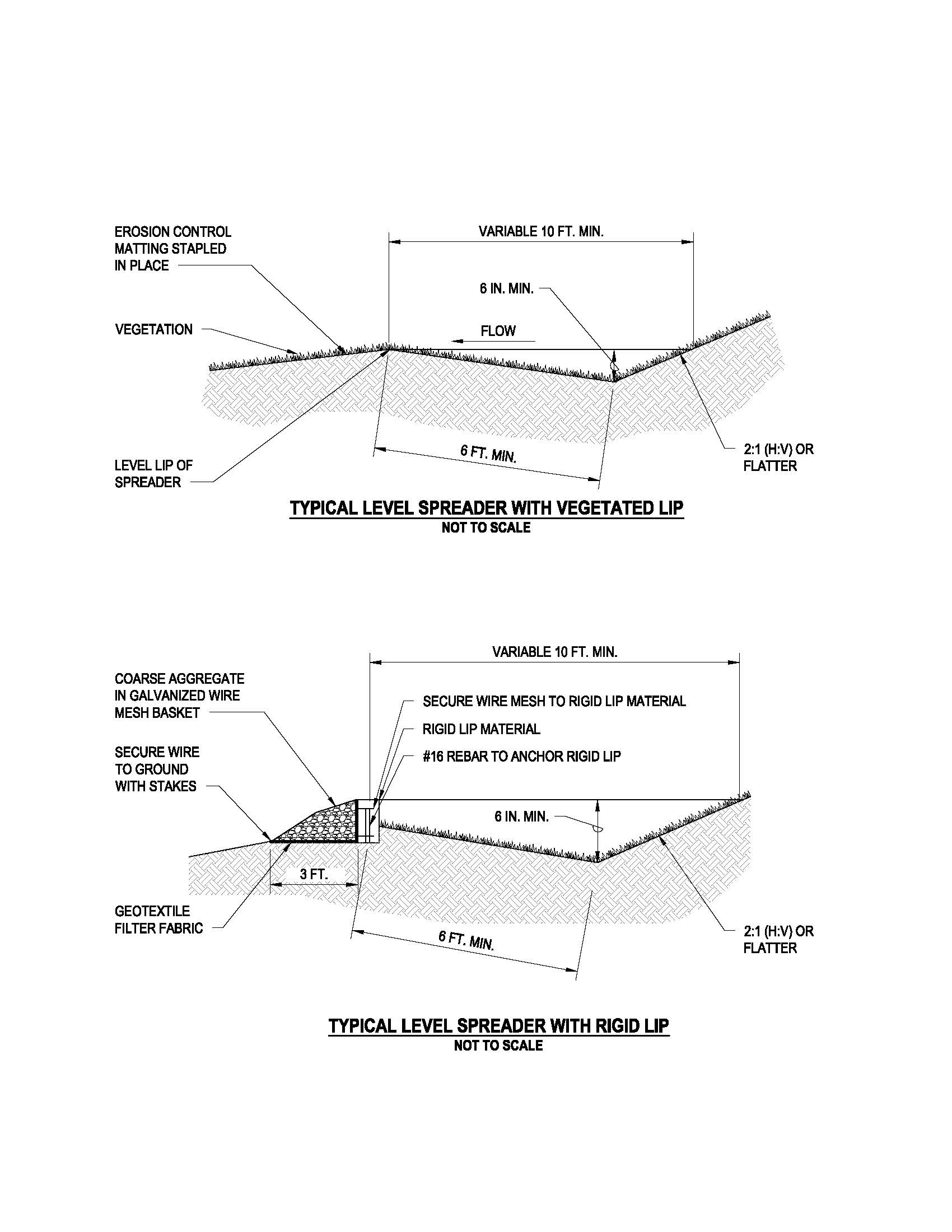

Description
Device used at outlets to convert concentrated flow to sheet flow, preventing erosion of the receiving area. Tops of channels, earthen berms, or rigid weir-like structures may function as level spreaders.
Applications
- Flat or gentle sloping areas.
- Outlets for dikes and diversions.
- Where concentrated flows are discharged.
Installation and Implementation Requirements
- Construct on undisturbed soil.
- Do not construct on fill material.
- Locate where reconcentration of water will not occur.
- A stabilized and well vegetated slope of less than 10% shall be located below the level spreader.
- Filter runoff containing high sediment loads through a sediment-trapping device prior to release to the level spreader.
- Incorporate a rigid outlet lip design for high discharge flows.
- 0% grade on the spreader lip is necessary for uniform sheet flow.
- Avoid operating vehicles and heavy equipment on the level spreader to maintain a smooth level surface for the overflow weir.
Considerations
- Not applicable to sediment-laden runoff.
- The level spreader lip needs to be at a 0% grade to confirm no erosion or concentration of flows occur.
- Not recognized as a pollutant reduction BMP when by itself, but is necessary for other BMP devices to function properly. It will also remove some pollutants due to some suspended sediment that settles out.
- Storm water approaching the BMP should not be high energy.
What to Inspect
- Is there accumulated debris or sediment in the level spreader?
- Does the level spreader have a slope of 0% along the spreader lip?
- Is there evidence of erosion, channelization, or concentrated flow at the discharge area?
- Are there low spots in spreader?
Maintenance
- Keep level spreader at 0% grade.
- Remove any accumulated debris and sediment and properly dispose off-site.
- Mow grass to assure the level spreader is properly functioning.