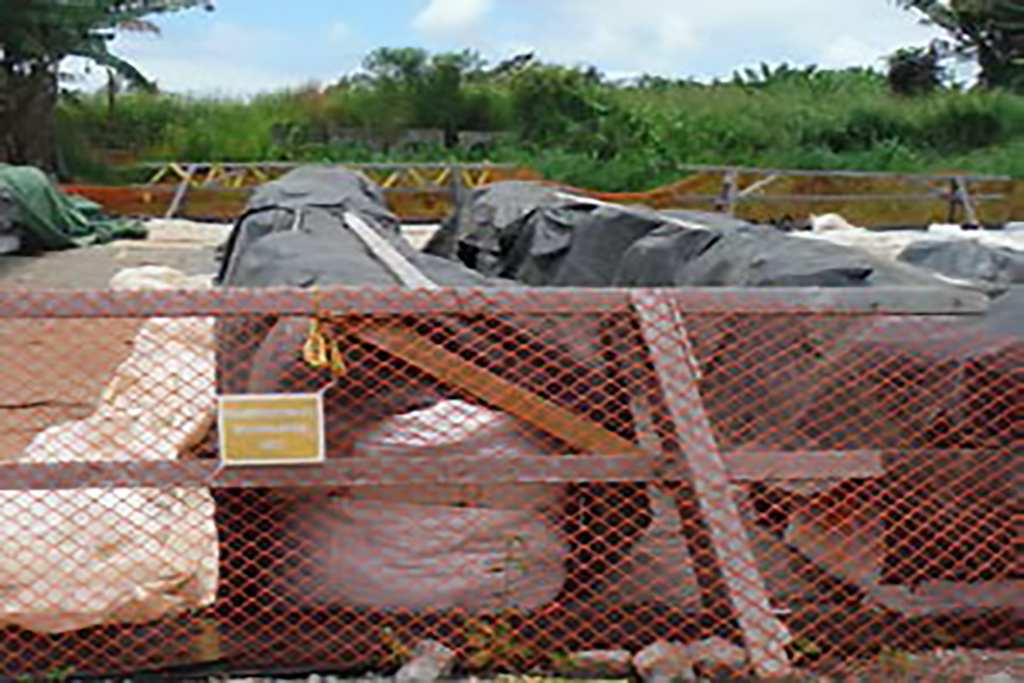

Description
Practices and procedures to identify and prevent the discharge of pollutants from contaminated soil to the drainage system and adjacent waterbodies.
Applications
- Projects in urbanized or industrial areas where previous site usage, undetected spills or leaks, illicit discharges, or underground storage tank leaks may have contributed to soil contamination.
Installation and Implementation Requirements
- Abide by all federal, state, and local regulations when dealing with contaminated soil.
- A site assessment should be conducted prior to ground-disturbing activity to identify contaminated soil or other hazardous pollutants.
- Research records of previous site uses and activities.
- Identify soil discoloration, odors, soil property differences, abandoned underground tanks or pipes, or buried debris to determine possible soil contamination.
- If contaminated soil or other hazardous pollutants are found on-site, stop work in the area immediately and notify the State of Hawaii Department of Health, Hazard Evaluation & Emergency Response (HEER) office (808-586-4249), as well as the Project Engineer.
- Contaminated soil shall be placed on an impermeable liner or device, such as 20-mil plastic sheeting, surrounded with impermeable lined berms and covered with impermeable sheeting.
- Soil suspected of being contaminated should be isolated from other stockpiles until test results return. If the suspected contaminated soil has evidence of contamination (odor, sheen, color, etc.), then it should be handled and stored as contaminated until testing determines otherwise. Known contaminated soil must be segregated from uncontaminated soil.
- Soil testing is the only option to know if soil is
contaminated. Sampling of the soil shall follow DOH guidelines and requirements. Test soil at a certified laboratory if soil is suspected of contamination. Multi Increment testing should be conducted if soil is contaminated with lead because it is commonly unevenly distributed. - The contractor shall propose the testing protocols for the Engineer’s approval.
- Contaminated soil stockpiles must remain on-site and cannot be transported or stored off-site without prior authorization.
- Temporary stockpiles of contaminated material must have signage designating material as contaminated.
- Identify area to temporarily store contaminated soil away from drainage facilities, waterbodies and conveyance systems.
- Construction vehicles leaving the excavation area must be clean of contaminated soil. All contaminated soil and wash water from vehicle cleaning must be properly contained, collected, and disposed of.
- Contaminated soil disposal options:
- Re-use on-site (not grossly contaminated)
- Off-site reuse (Refer to DOH Guidance for Soil Stockpile Characterization and Evaluation of Imported and Exported Fill Material)
- Landfill disposal (check with landfill)
Considerations
- Dispose of contaminated soils at DOH-permitted facilities. Transfer contaminated soils via DOH-approved transporter.
- This manual does not explain environmental laws and regulations. Therefore, it is required to have a licensed contracting firm that is experienced in handling contaminated and hazardous materials when dealing with contaminated soil.
- Site-specific conditions may require the use of additional personal protective equipment (PPE). Gloves and safety glasses must be worn when dealing with contaminated soil.
- A removal action may be conducted either as a stand-alone response action, or as an interim response action to be followed by further removal or remedial action at a later date. In addition, a removal action may result in long-term management of contamination on site. Each of these different types of removal actions has implications for site closure.
What to Inspect
- Are stockpiles of contaminated soil stored on an impermeable liner or device, surrounded by an impermeable lined berm, and completely covered with impermeable material?
- Are the BMP measures installed properly and maintained?
- Has the contaminated soil been properly tested, per DOH guidelines and requirements?
- Is the contaminated soil in contact with non-contaminated bare soil?
- Has the contaminated soil come into contact with rainwater?
- Is the contaminated soil stockpile isolated from other stockpiles?
Maintenance
- Prevent leaks and spills by implementing spill prevention and control practices and procedures. See section SM-10 Spill Prevention and Control for more information.
- Repair tears and rips to the impermeable berm and cover to ensure erosion is prevented.
- Damaged perimeter control devices must be repaired/replaced when the device is not functioning as designed.
- Repair/replace barriers that no longer prevent contaminated soil from coming into contact with bare soils.
BMP Examples
Are adequate BMPs installed to prevent the discharge of pollutants from the project site? Hover over each photo for an explanation of the situation presented and if BMPs have been installed properly.