Description
Practices and procedures to prevent or reduce the discharge of pollutants from vehicle and equipment maintenance. When vehicles and equipment need maintenance, the best option is to perform these activities off-site to avoid spills and leaks on-site. If on-site maintenance activities are necessary, they should be conducted in an approved designated area.
Applications
- Construction sites with vehicle and equipment maintenance areas.
- Construction sites where vehicle and equipment are stored when not in use.
- Construction sites where vehicle and equipment are idle, but intermittent use is occurring.
Installation and Implementation Requirements
- Prevent excessive accumulation of oil and grease by keeping vehicles and equipment clean.
- Use off-site repair and maintenance facilities where practical.
- Repair oil and fluid leaks immediately.
- Immediately place a drip pan or drip pad under the vehicle once a leak is observed until repairs can be made.
- Designate a leveled maintenance area away from drainage courses and inlets to prevent pollutants from entering the drainage system.
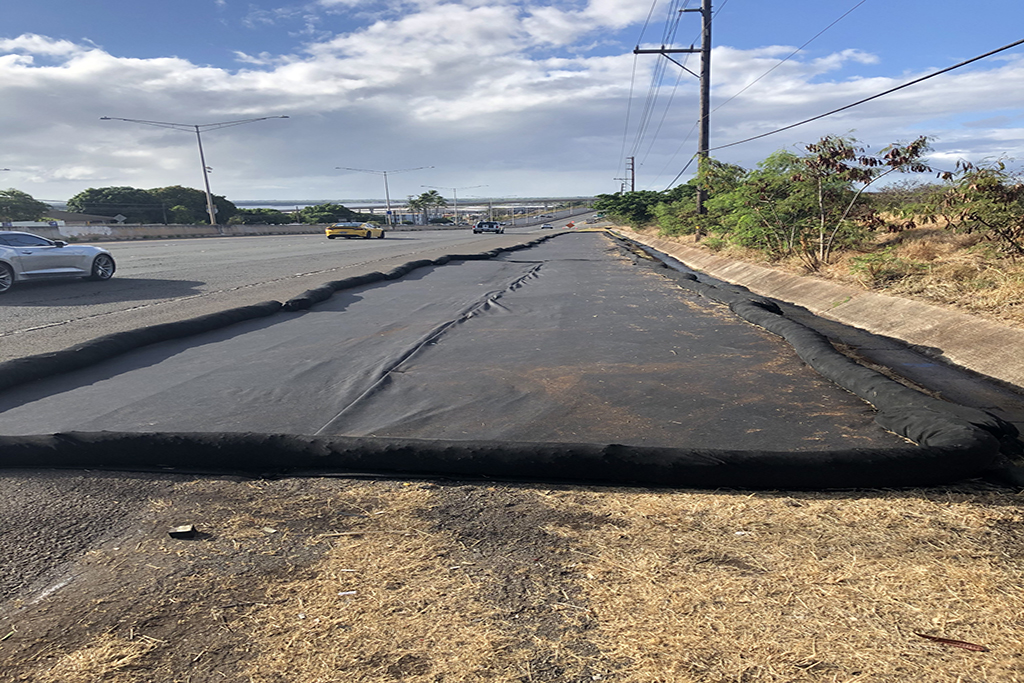
- Store vehicles and equipment that need maintenance on a layer of geotextile filter fabric on top of 10 mil plastic sheeting before conducting maintenance activities. Perimeter controls must be placed along the perimeter of the maintenance area and underneath the impermeable material, to create a berm able to contain any possible spills and/or leaks.
- Have an ample supply of readily accessible spill cleanup materials on-site, at all times.
- Use absorbent materials on small spills. Promptly remove and properly dispose of absorbent materials. Do not hose down or bury small spills. See section SM-10 Spill Prevention and Control for more information.
- Check vehicles and equipment regularly for leaks. Leaking vehicles and equipment shall not be allowed on-site.
- Keep maintenance areas clean and orderly to minimize oil and grease buildup.
- Segregate and recycle wastes from vehicle/equipment maintenance activities such as used oil, oil filters, greases, hydraulic and transmission fluids, cleaning solutions, antifreeze, and automotive batteries.
- Oil, fuels, fluids and lubricants should be recycled whenever possible. Do not dump on the ground or pour into storm drains.
- Properly dispose of wastes generated by vehicle/equipment maintenance activities.
- Provide employee training on proper maintenance and spill cleanup practices and procedures.
Considerations
- Off-site maintenance facility may not be easily accessible.
- Vehicle and equipment maintenance should only be used when off-site maintenance is impractical.
What to Inspect
- Are leaks and/or spills coming from vehicles and/or equipment?
- Is there evidence of oil, grease, fluids, lubricants, etc. on the ground?
- Are spill cleanup materials available on-site?
- Are vehicles and equipment properly stored on a layer of geotextile filter fabric on top of 10 mil plastic sheeting?
- Are berms properly aligned along the perimeter of the maintenance area?
- Is the maintenance area on leveled ground away from drainage courses?
- Are maintenance areas kept clean and orderly?
- Are vehicles being taken off-site for maintenance?
Maintenance
- Maintain an adequate supply of spill cleanup materials on-site.
- Remove used oils, antifreeze, grease, lubricants, etc. routinely.
- Do not allow used oils to accumulate on-site.
- Maintain adequate supplies of spill cleanup materials on-site.
- Leaking vehicles and equipment shall be repaired promptly.
- Leaks and spills shall be cleaned up immediately.
- Maintain impermeable material/plastic sheeting, geotextile filter fabric, and perimeter control to ensure proper effectiveness.
BMP Examples
Are adequate BMPs installed to prevent the discharge of pollutants from the project site? Hover over each photo for an explanation of the situation presented and if BMPs have been installed properly.