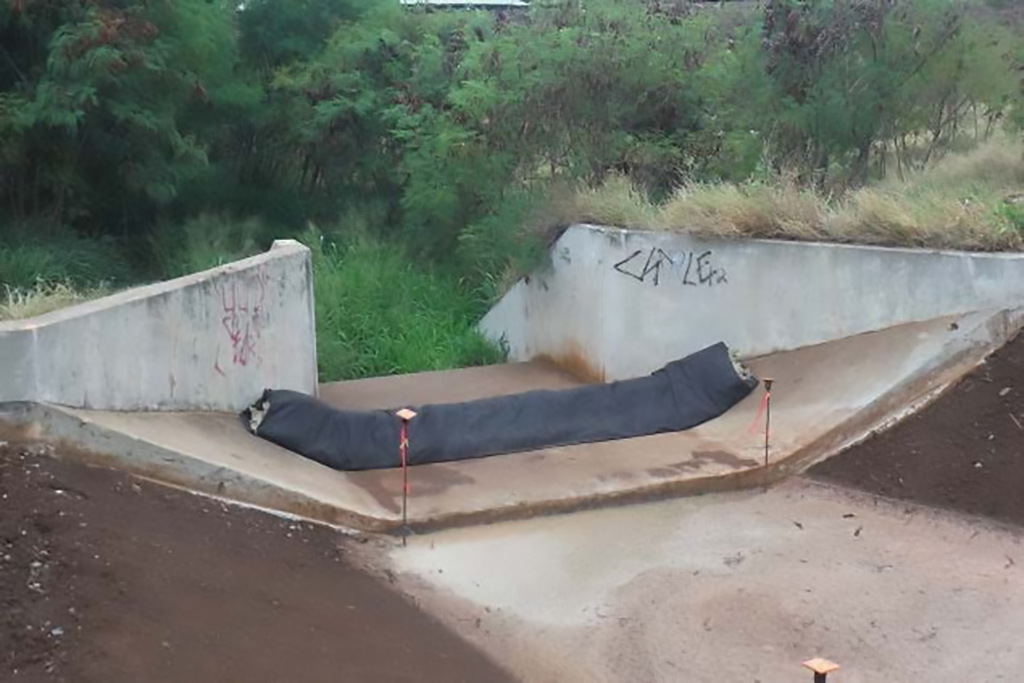

Description
Filter berms constructed of brush or rock placed across a level contour area where sheet flow may occur to trap sediment and reduce flow velocity.
Applications
- Check dams across construction roads with mild slopes.
- Below the toe of slopes.
- Along the site perimeter, streams, or channels.
- Around temporary spoil areas.
- Downstream of small cleared areas.
- Sediment traps at culvert or pipe outlets.
Installation and Implementation Requirements
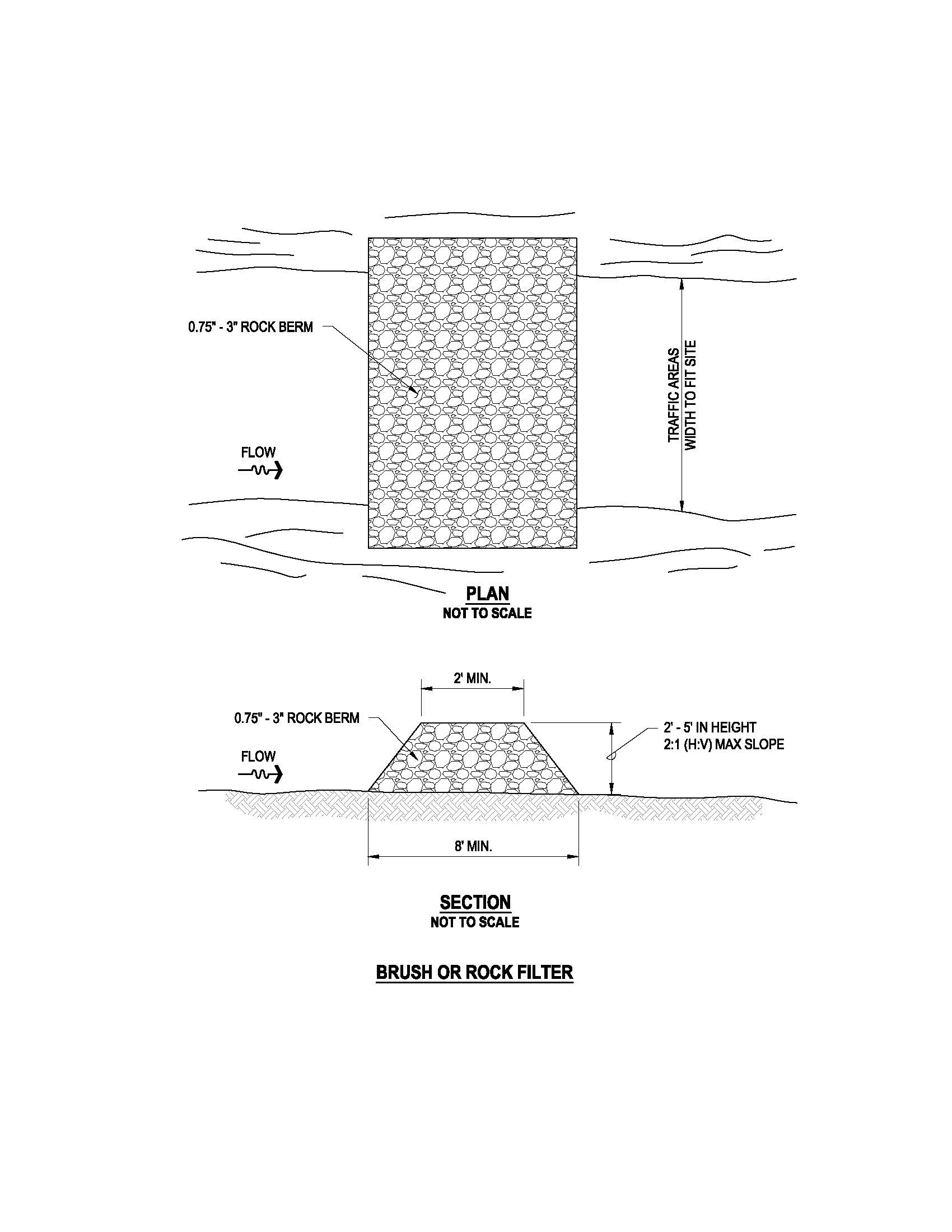
- Use stones between 0.75 to 3 inches in diameter or brush wrapped in geotextile filter fabric. Brush from site clearing may be used. Place across areas of sheet flow.
- Installation of rock filter berms with geotextile filter fabric should be used when possible.
- A brush filter berm can be made of brush, small tree limbs, grass, leaves or other waste material from clearing and grubbing.
- Brush filter berms must be 2 to 5 feet in height to detain storm water. The base width of the berm must be 5 to 10 feet with a shape that is either a triangle or slightly rounded.
- Install filter 5 to 7 feet from toe of slope to allow ponding.
- Larger rocks must be placed as the base of the berm. Smaller rocks must be placed on the uphill side to form a natural filter.
- Place larger rocks without fines in a gabion to stabilize areas of concentrated flow.
- Use larger stones placed in staked and woven wire sheathing if stones are used across an area of concentrated flow.
- Construct along a level contour.
- Provide an area behind berm for detention and sedimentation.
- Geotextile filter fabric, rope, or wire mesh screen can be used to keep the shape of the berm intact.
- Install the geotextile filter fabric into a 6-inch-deep trench uphill from berm.
- Secure filter fabric with staples, stakes, or rope to protect the brush from being displaced from wind or a storm.
Considerations
- Adequate detention area behind berm is necessary to prevent flooding upstream.
- Drainage area shall not exceed 5 acres.
- Removal of stone berms may be difficult, resulting in limited usefulness in landscaped areas.
- Must not be used in continuously flowing streams.
- Ponding may occur if not sized properly.
What to Inspect
- Has rock or brush been displaced?
- Is ponding occurring in undesired areas?
- Is there evidence of erosion or sheet flow?
- Is the height and width of the device appropriate for the flow?
Maintenance
- Reshape berm and replace any missing or dislodged stone or brush.
- Remove and dispose of sediment on upstream site of filter upon reaching a depth of 6 inches.
- Replace geotextile filter fabric when tears and rips limit effectiveness.
BMP Examples
Are adequate BMPs installed to prevent the discharge of pollutants from the project site? Hover over each photo for an explanation of the situation presented and if BMPs have been installed properly.